Building Local-First Intelligence: Why We Ditched the Cloud
We rethought everything about AI infrastructure. Instead of sending your data to a datacenter, Zap keeps intelligence where it belongs — on your devices.
Zap Team
Engineering
When we started building Zap, we asked ourselves a simple question: Why does AI need the cloud?
The answer, surprisingly, is that it doesn't — at least not for most use cases. Modern Apple Silicon chips pack enough neural engine power to run sophisticated language models entirely on-device. The M-series chips in MacBooks and the A-series chips in iPhones and iPads are capable of billions of operations per second.
The Problem with Cloud AI
Cloud-based AI has three fundamental issues:
1. **Latency** — Every query takes a round trip to a server. Even with the fastest connections, you're looking at 200-500ms of overhead per request.
2. **Privacy** — Your data leaves your device. Your meeting transcripts, your documents, your questions — all sent to someone else's computer.
3. **Availability** — No internet? No AI. This is unacceptable for mission-critical workflows.
Our Approach: The Local Mesh
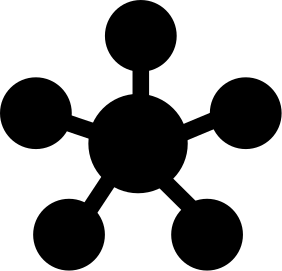
Zap takes a radically different approach. Instead of one powerful server, we use every device in the room as a node in a distributed intelligence network.
Your MacBook becomes a compute node. Your colleague's iPad becomes a retrieval node. The iPhone on the conference table becomes a transcription node. Together, they form a collective brain — faster, more private, and more resilient than any cloud service.
How It Works
Each device in the Zap network runs a lightweight agent that:
•Indexes local documents and context using on-device embeddings
•Advertises its capabilities over MultipeerConnectivity
•Responds to queries from other nodes using local RAG (Retrieval-Augmented Generation)
The result? Sub-millisecond context retrieval. Zero data exfiltration. And an AI that actually understands your team's full context, not just what you typed into a chat box.